The Perfection of Giving
All Buddhas, Bodhisattvas, Venerable Master, Dharma Masters, wise teachers, and Dharma friends: good evening. My name is Thao Phi Laughton. Tonight, I will share about my affinity with the pāramitā of dāna, the perfection of giving.
While I was preparing for this talk, I serendipitously saw Nāgārjuna on the Six Perfections on my bookshelf.
What does it mean to give?
“Dāna refers to an instance of giving wherein there is a corresponding instance of wholesome intentionality” (p.43). We can give on the material realm - such as wealth or physical goods. We can give in the immaterial realm - time or words. And then there’s the giving of dharma.
What are the benefits of giving?
Dāna serves as a treasure trove which constantly follows along with a person.
Dāna destroys suffering and bestows bliss on people. [...]
Dāna is a house of goodness for it draws in good people.
Dāna is a source of peace and security. [...]
Dāna itself is itself marked by kindness, for it is able to bring about the rescue of everyone. [...]
Dāna is the mark of the good person endowed with blessings-generating karma.
Dāna destroys poverty and cuts one off from the three wretched destinies.
Dāna is able to preserve and protect the fruit of karmic blessings and bliss.
Dāna is the primary condition for the realization of nirvana. [...]
It is that which everyone else, including those of minor virtue and less intelligence, should strive to emulate” (p.35-37).
Several other benefits are listed in the text. Furthermore, giving gets rid of afflictions and generates good dharmas (p.47-57).
When I spoke last year, it was shortly after the Ten Thousand Buddhas Jeweled Repentance concluded. I fulfilled my intention to attend at least one incense a day and took time off work during the last week to focus on the bowing session. Throughout the session, various hindrances came up: I was in physical pain, I had sadness over lack of connection to family, I went to a celebration of life, I was unhappy at my job, and I interviewed for a new job that I really wanted. On the last day of the bowing session, I was offered the new job.
Everything is interconnected, and it can be hard to distinguish where one thread begins and another ends. During this year’s spring Guan Yin session, two significant events occurred: I gained more responsibility at work and began to communicate with my family in Vietnam.
This year’s bowing session felt like a continued season from last year, and the way I view giving has evolved over the course of the last year.
“The great man of great mind is able to give greatly. Thus he becomes able to naturally benefit himself as well. The petty man of petty mind is not only unable to benefit others, but he is also unable to bestow liberal generosity upon himself” (p.39).
I am convinced that my participation and sincerity in last year’s bowing session got me my current job. It is one that I feel personally and spiritually aligned with.
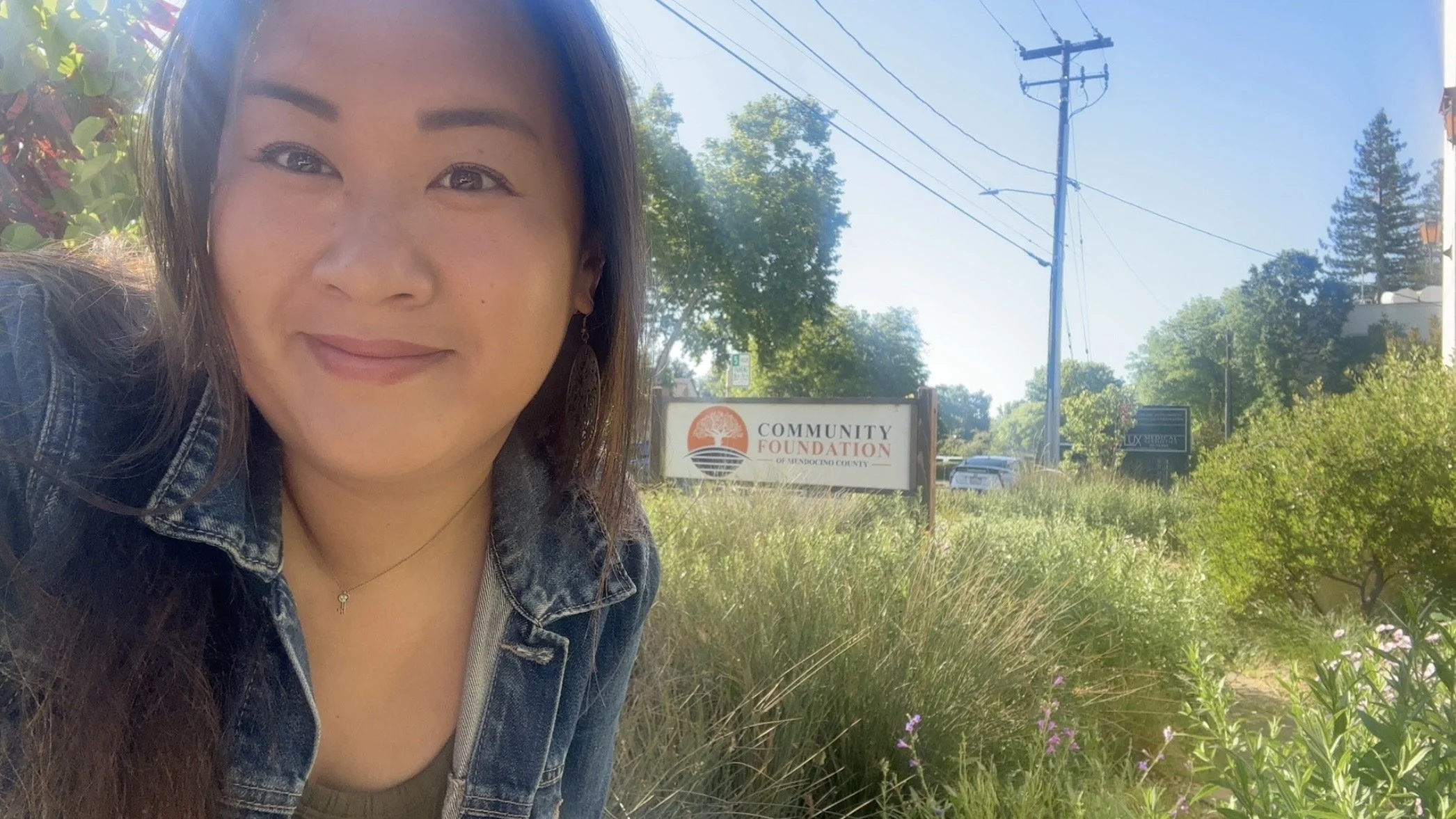
I work at the Community Foundation of Mendocino County. What do we do? We steward the wealth of donors and benefactors. All of the initiatives benefit those who live in or are from Mendocino County through grants to nonprofits and scholarships to students. Generosity is explicitly named as one of our core values.
Another part of my dharma talk from last year was the feeling of a lack of relationship to my maternal side of the family. A family member shared contact information of my brother, whom I have only met once in 2004. It is only in these recent years that technology has advanced enough for instant communication across the world, and it also takes basic wealth to have the capability to use such a resource.
I decided to reach out to my family. I sent a WhatsApp message to my cousin, who quickly responded. Shortly, after that, we were on a video call. He passed the phone to my aunt, who was at the temple. It was Sunday morning, and she was cooking lunch for disciples who came to listen to the Dharma. She then passed the phone to other aunts and uncles, who cried because they were so overjoyed to hear from me and said I looked like my mother. For the first time in over twenty years, I saw my brother, who has aged and is severely handicapped with disabilities.
Even though we were across the world from each other, we had things in common. Even though there was a language barrier, there was a connection.
Shortly after we got off the phone, I transferred money to my family. I thought it was the least I could do after seeing their living conditions. My aunt and cousin have been taking care of my brother for more than twenty years. I am living a very comfortable life, where it felt like I had enough to share.
The next day, I cried and cried. Reconnecting with my family was bittersweet. It was joyful and meaningful to connect with my maternal side of the family, since it was what I previously wanted. It was also very sudden and overwhelming. I recognized the great differences between our conditions, feeling both very fortunate and helpless in changing theirs.
Around the same time I got in touch with my family, my work responsibilities evolved. A community initiative that was faltering needed new energy so I volunteered to lead the transition. This community event happens twice a year, once in spring and once in fall. The community initiative is called 100 Women Strong, with the idea being that if 100 women each contributed $100 dollars, that would be $10,000 raised for a local nonprofit.
I assumed with the new role I took on and transition, the spring event would be postponed. Shortly after I agreed to step into the leadership role, the group decided the spring event should happen in six weeks. When I looked at the calendar, I saw that the spring event was scheduled on the night before the last day of the bowing session.
Although it was not expected that I personally raise $10,000 — I felt some responsibility to the nonprofit organizations that agreed to participate in this event. Six weeks was a very short turnaround time to coordinate an event while also ensuring the money we were promising to give out would actually be there.
Like last year, it was my intention to attend at least once incense of the bowing session every day. Throughout the month of the bowing session, I was also occupied with fundraising to meet the $10,000 goal. Since the last day of the bowing session was around the same time I needed to meet the fundraising goal, I loosely used the Buddha count to see if we were on track for fundraising.
In the bowing session, we bow to 11,100 Buddha, Bodhisattva, and Pratyekabuddha names. Every 100 bows, we acquire the Buddha’s 32 major hallmarks and 80 minor hallmarks. Nāgārjuna goes on to say that giving is what generates these hallmarks (p.51).
I thought the event I was tasked with and the bowing session went hand-in-hand together. I suggested to someone that they share the event with the wider community, and they did not think people would donate to the cause. I was surprised that this person thought this way, and the shock made me immediately connect giving to the Buddhist path and bowing session.
If someone is unable to give because of their current conditions, there is no use in shaming or guilting them. However, if we are able to give, what a blessing that is! It is very fortunate if we have the conditions to be able to give, and it is in alignment with the Buddhist path. Afterall, giving is the first pāramitā, dāna.
The heart of the bowing session constantly goes back to giving. Every morning after the incense praise and flower offering, we recite vows before the bowing begins.
“May we quickly fulfill Bodhisattva Samantabhadra’s vows of practice. And to the end of time, may we unceasingly adorn the Dharma Realm with our blessings and wisdom, as well as the giving of wealth and Dharma.
普賢行願,疾得圓滿。財法二施、福慧二嚴,窮未來際莊嚴法界,願不休息”
Every afternoon during the transference, we share and give back the goodness we have done.
“May I perfect the practices of the pāramitās
And dedicate the merit and virtue toward realizing unsurpassed Bodhi.
May I perfect all the pāramitās of the Bodhisattvas;
From this day forth, I shall learn the practices of supreme generosity from the Bodhisattva-Mahasattvas of the past, present, and future.
願滿足波羅蜜行,
願回向無上菩提。
願滿足一切菩薩諸波羅蜜。
從於今日, 我學過去、未來、現在菩薩摩訶薩,修行大捨。”
Another interesting occurrence during the bowing session was when my work held a spring celebration at the girl’s school. It was like several realms colliding together, my workplace was meeting at my wayplace.
My colleagues knew I was attending the bowing session over the month. Whenever I saw a Buddha name that reminded me of them, I would share the name with them. Since they were on campus, it was an opportunity to bring them to the Buddha hall. Afterward, I took them to the Long Life Hall so they could see the English translation.
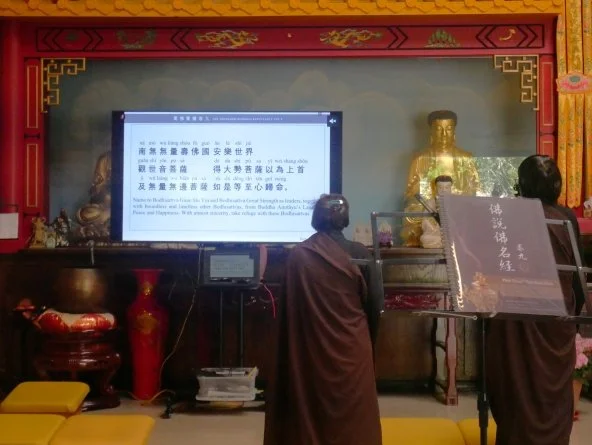
We sat on the bench to watch the English names project onto the screen:
Namo to Guan Shi Yin Bodhisattva and Great Strength Bodhisattva as leaders, together with boundless and limitless other bodhisattvas, from Amitabha Buddha’s Land, Peace and Happiness. With utmost sincerity, we take refuge with these Bodhisattvas.
南無無量壽佛國安樂世界 觀世音菩薩 得大勢菩薩以為上首 及無量無邊菩薩 如是等至心歸命。
That evening, I told my husband about the Buddha name we encountered when I brought my coworkers into the Long Life Hall. “We saw Guan Yin Bodhisattva’s name, who dwells in Amitabha’s western pure land. That makes sense that we would see that name together.”
He asked me, “Do we live in the western pure land?” I told him that we do. “That makes sense,” he replied.
That same day, we were about nine days from the event and still less than halfway to our fundraising goal. I was getting nervous. I asked different people who I thought might give. The number of people I asked was the number of different responses I got: some hesitated, some gave with no second thought, some gave partially, others were miserly. It made me think back to the afternoon transference: if you are not willing to give $100, you probably would not give away your fingers or other body parts.
It gave me a different perspective on the donors we work with. Many donors are those who plan to give after they pass away. What they give while they are alive may vary, but being willing to give when they pass away is still a seed of generosity planted.
A few days earlier, I received a message from my cousin. He wanted to move to another unit to give my brother more space and so my aunt could have her own space. He wanted to start selling drinks like coffee, milktea, and juice to have a better quality of life. He asked if I would be willing to give more money. I hesitated.
“By providing comfort to others through encouraging them to practice giving while one is oneself engaged in giving, one opens up the way to giving.” (p.53, Nāgārjuna on the Six Perfections)
Shortly after we bowed to the 10,000th Buddha name, we also reached the $10,000 fundraising goal.
How can I ask others to give, if I am not willing to give myself? If I am asking others to donate to a cause, I must be willing to contribute as well. I thought back to my cousin who asked for money. If my professional and spiritual selves emphasize giving and generosity, why was I being miserly toward my family? Where was the stinginess in my heart coming from?
When the total amount was finalized for the fundraiser, not only did we meet our goal but we far surpassed it. $18,300 was raised for three nonprofits in Mendocino County over six short weeks. It was thanks to the generosity of community members. Some donations came from people who do not live in Ukiah but were either at the bowing session or had a connection to the temple. This helps them plant seeds to be invested in the local community.
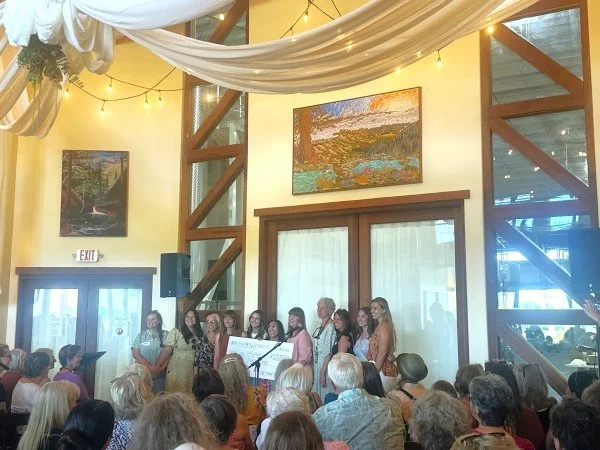
Giving and being generous is not always where we are at, but certainly as a Buddhist, it is where we aspire to be. These recent events in my personal, social, and spiritual worlds all asked me to look at where I am when it comes to giving.
After a busy spring season, this summer is for reflection and writing. I am getting ready for an academic Buddhist conference in Vancouver, Canada on Pure Land Buddhism and the earth. I will present a paper that is based on the Long Amitabha Sutra and how we can transform turbidity into the Pure Land, right here and now, on the current earth we live on, through vegetarianism, less of the three poisons, and slow living.
I will close with an excerpt on Amitabha’s Vows to Rescue Living Beings:
“If I do not become a generous donor for endless cosmic ages, recusing everywhere the destitute and suffering, I pledge I will not realize perfect awakening.”
Thank you for listening. Amituofo.